Und selbst Raumschiff Cosinus von Tanja Abou stellt für jüngere Leser*innen die Frage, wer eigentlich dafür sorgt, dass alles funktioniert.
Vom Berliner Club bis zum Raumschiff:
Arbeit organisiert einen großen Teil unseres Lebens.
Darüber zu sprechen, wie sie verteilt, bezahlt, anerkannt und verändert wird, bleibt deshalb eine gesellschaftliche Frage.
Who Works – and Under What Conditions?
October 7 is the World Day for Decent Work.
In 2026, particular attention is being paid to young workers and their experiences of low wages, insecure employment and precarious working conditions.
But “decent work” cannot be understood through an employment contract alone.
Who works? Who decides? Which work is paid? Which work remains invisible? And what happens when workers organise?
Shshshshift, edited by ( ) s-p-a-c-e, brings together conversations with workers from Berlin’s queer club and rave culture and explores labour between passion, exhaustion, precarity and commercialisation.
Wohnen, Reichtum und der Kampf um soziale Sicherheit
Zum World Habitat Day 2026: über Vergesellschaftung in Berlin, den Rechtsruck, Klassismus und Antifaschismus, unsichtbare Arbeit, Vermögensungleichheit, Antirepression – und darüber, warum unabhängiges Publizieren gerade jetzt wichtig ist.
Am 5. Oktober ist World Habitat Day. 2026 steht der internationale Aktionstag unter dem Motto „Adequate Housing for All“ – angemessener Wohnraum für alle. UN-Habitat stellt damit die globale Wohnungskrise und das Recht auf angemessenen Wohnraum ins Zentrum.
Für edition assemblage ist die Wohnungsfrage seit Langem mehr als eine Frage von Häusern und Wohnungen. Sie berührt Eigentum und Einkommen, Arbeit und Migration, Klassismus und Verdrängung, Stadtentwicklung und demokratische Mitbestimmung.
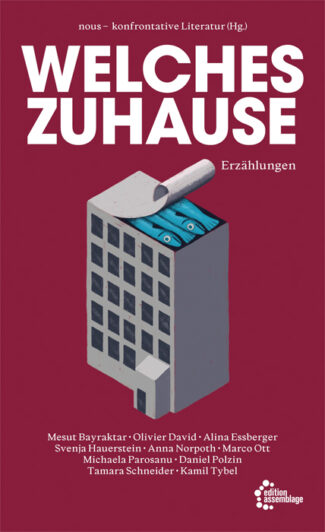
Davon erzählen Bücher wie Welches Zuhause? von nous – konfrontative Literatur. Die zehn Erzählungen stellen Wohnungsnot, Gentrifizierung und die Profitlogik auf dem Wohnungsmarkt aus der Perspektive Betroffener ins Zentrum.
Das Haus gehört UNS ALLEN! von Tanja Tschöke dokumentiert Hausbesetzungen und selbstverwaltete Gemeinschaftsprojekte in Hannover und zeigt, wie Aktivismus Stadtentwicklung verändern kann.
Umkämpftes Wohnen richtet den Blick auf Organisierung und Kämpfe um Wohnraum. Arbeit! Wohnen! verbindet die Wohnungsfrage mit Migration, Arbeitsverhältnissen und städtischen Konflikten.
In Berlin bekommt diese Frage gerade eine neue Aktualität.
Berlin nach der Wahl: Wohnen ist eine Machtfrage
Bei der Wahl zum Berliner Abgeordnetenhaus am 20. September 2026 wurde Die Linke mit 25,7 Prozent der Zweitstimmen stärkste Kraft. Gleichzeitig legte auch die AfD zu und erreichte 16,3 Prozent. Die amtlichen Wahlergebnisse dokumentieren damit zwei sehr unterschiedliche politische Entwicklungen.
Gerade deshalb lohnt ein genauer Blick auf die Motive hinter dem Berliner Ergebnis.
Unter den Wähler*innen der Linken nannten laut infratest dimap Wohnen und soziale Sicherheit als besonders wichtige Themen ihrer Wahlentscheidung. Auch bei der Frage nach politischen Kompetenzen wurde der Linken insbesondere bei bezahlbarem Wohnraum und sozialer Gerechtigkeit Kompetenz zugeschrieben. Die Tagesschau hat die Ergebnisse der Nachwahlbefragung aufbereitet.
Berlin beweist damit nicht, dass eine einzelne sozialpolitische Forderung die extreme Rechte einfach „stoppen“ kann. Dafür ist schon das gleichzeitige Wachstum der AfD ein Gegenbeleg.
Das Ergebnis zeigt aber etwas anderes:
Konkrete Antworten auf soziale Fragen können Menschen für demokratische politische Alternativen mobilisieren.
Und die Wohnungsfrage ist dafür ein besonders anschauliches Beispiel.
Vergesellschaftung: ein demokratischer Auftrag, der noch immer offen ist
Der Konflikt ist älter als diese Wahl.
Beim Volksentscheid „Deutsche Wohnen & Co enteignen“ stimmten 2021 57,6 Prozent der Teilnehmenden mit Ja. Der Beschluss zur Erarbeitung eines Gesetzes für die Vergesellschaftung der Wohnungsbestände großer privater Wohnungsunternehmen wurde damit angenommen. Die Ergebnisse dokumentiert das Land Berlin.
Fünf Jahre später ist diese Forderung noch immer nicht umgesetzt.
Die Berliner Linke hat 2026 angekündigt, die Umsetzung des Volksentscheids zu einem zentralen Punkt möglicher Koalitionsverhandlungen zu machen. Nach ihrem Beschluss zur Vergesellschaftung sollen vergesellschaftete Wohnungsbestände gemeinwirtschaftlich und nicht profitorientiert durch eine Anstalt des öffentlichen Rechts (AöR) verwaltet werden. Belegschaft, Mieter*innen und Stadtgesellschaft sollen an der Verwaltung beteiligt werden.
Das ist noch keine umgesetzte Politik. Es ist eine politische Forderung und Gegenstand kommender Auseinandersetzungen und Verhandlungen.
Als edition assemblage sind wir solidarisch mit Mieter*innen, Initiativen und sozialen Bewegungen, die für bezahlbares Wohnen, gegen Verdrängung und für demokratische Kontrolle über zentrale Lebensbereiche kämpfen.
Uns geht es dabei nicht um Loyalität zu einer Partei.
Uns interessiert die grundsätzlichere Frage:
Was geschieht, wenn soziale Konflikte als soziale Konflikte sichtbar werden – statt diejenigen gegeneinander auszuspielen, die selbst von Unsicherheit, Armut oder Ausgrenzung betroffen sind?
Soziale Fragen nicht den Rechten überlassen
Der Blick nach Sachsen-Anhalt macht deutlich, warum darauf keine einfache Antwort möglich ist.
Bei der Landtagswahl im September erreichte die AfD dort 43,8 Prozent der Zweitstimmen. Der Landesverband Sachsen-Anhalt wird vom dortigen Verfassungsschutz als gesichert rechtsextremistische Bestrebung eingestuft.
Gleichzeitig zeigen Nachwahlbefragungen, dass materielle Sorgen auch unter AfD-Wähler*innen verbreitet sind. Sorgen um steigende Preise und den eigenen Lebensstandard werden deutlich.
Das heißt gerade nicht, dass Armut Menschen rechts macht.
Eine aktuelle Auswertung von SOEP-Daten kommt sogar zu dem Ergebnis, dass Sorgen um Migration für die Unterstützung der AfD wesentlich erklärungskräftiger sind als sozioökonomische Benachteiligung.
Aber es wäre ebenso falsch, soziale Unsicherheit, steigende Lebenshaltungskosten und Erfahrungen von Kontrollverlust aus der Analyse herauszuhalten.
Politisch entscheidend ist auch, wie Krisen erklärt werden.
Werden steigende Mieten als Konflikt um Eigentum und Verteilung verstanden?
Oder werden gesellschaftliche Probleme nationalistisch und rassistisch umgedeutet und andere Menschen zu Schuldigen erklärt?
Hier beginnt für uns auch eine notwendige Kritik innerhalb antifaschistischer und linker Zusammenhänge.
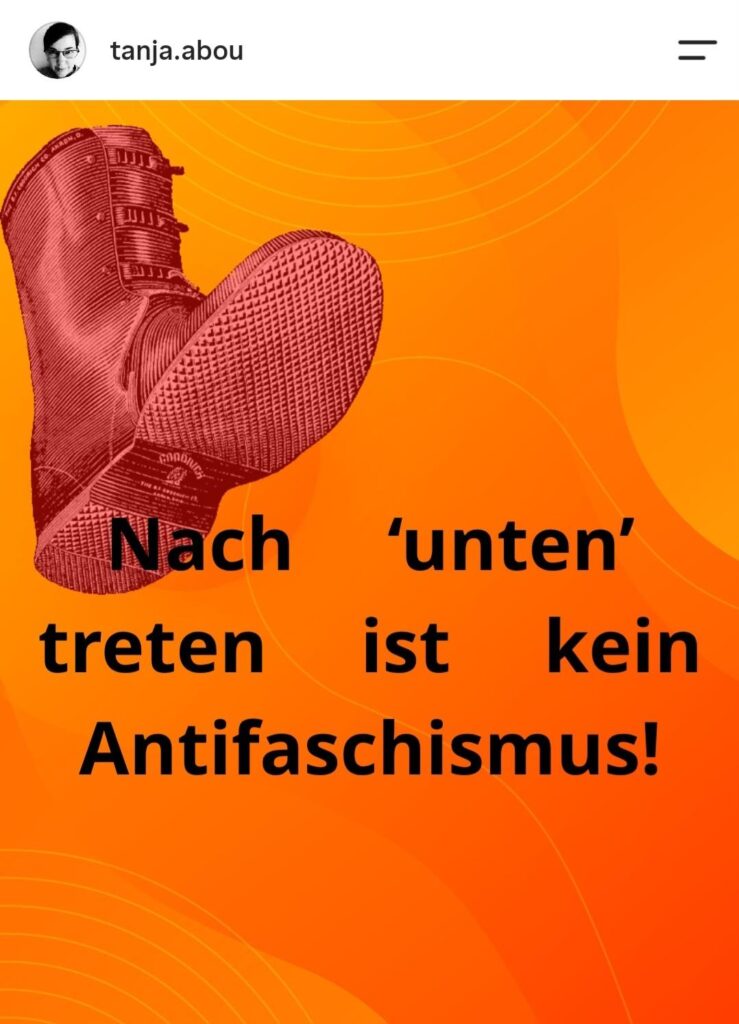
„Nach unten treten ist kein Antifaschismus“
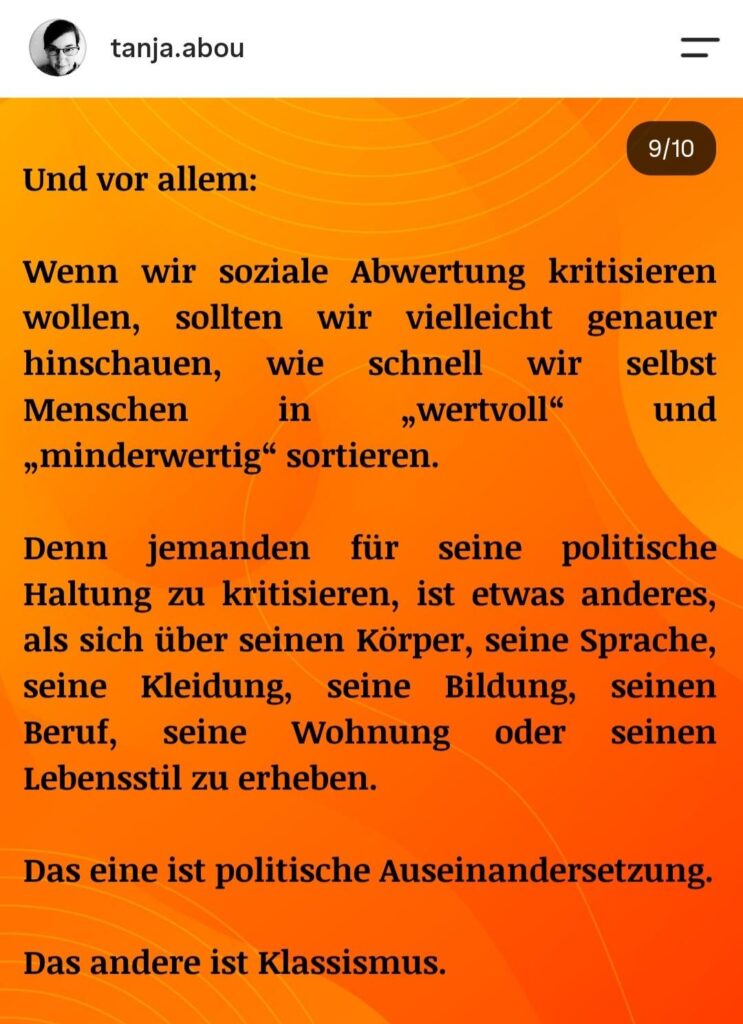
Die queere Poverty-Class Akademikerin, Social-Justice-Trainerin und Kinderbuchautorin Tanja Abou (Raumschiff Cosinus Der Bordcomputer hat die Schnauze voll) interveniert nach der Wahl in Sachsen-Anhalt gegen ein auch in großen Teilen der Linken vertrautes Stereotyp: den angeblich typischen rechten Wähler (häufig männlich dargestell) als arm, ungebildet, „prollig“, irgendwo im Plattenbau oder auf dem Dorf. Dazu gehörten die stilistischen Klischees: Rauchen, Trinken, Übergewichtig – die nur im Kontext von „arm“ und „prolig“ als negativ gewertet werden.
Abou relativiert damit rechte Einstellungen nicht.
Im Gegenteil: Sie schreibt ausdrücklich, dass rechte, rassistische, antisemitische, antifeministische und autoritäre Positionen kritisiert werden müssen.
Ihr Einwand richtet sich dagegen, diese politischen Positionen über soziale Herkunft oder Habitus zu erklären.
Wenn Faschismus mit mangelnder Bildung, Armut, bestimmten Körpern, Kleidung, Sprache oder einem vermeintlich „prolligen“ Lebensstil verbunden wird, entsteht schnell das Bild des falschen Menschen, der stellvertretend für das politische Problem steht.
Die gebildete und materiell abgesicherte Mitte kann sich dann selbst beruhigt aus dem Problem herausdefinieren.
Abou erinnert außerdem daran, dass solche sozialen Sortierungen eine deutsche Geschichte haben.
Menschen wurden während des Nationalsozialismus als sogenannte „Asoziale“ verfolgt, unter anderem weil sie arm oder wohnungslos waren, als „arbeitsunwillig“ galten oder nicht in die Vorstellung einer disziplinierten und gesellschaftlich „nützlichen“ Person passten. Viele Betroffene wurden nach 1945 jahrzehntelang nicht als NS-Verfolgte anerkannt.
Ihr entscheidender Unterschied lautet:
Eine politische Haltung zu kritisieren ist etwas anderes, als Menschen wegen ihres Körpers, ihrer Sprache, ihrer Kleidung, ihrer Bildung, ihres Berufs, ihrer Wohnung oder ihres Lebensstils abzuwerten.
Das eine ist politische Auseinandersetzung.
Das andere ist Klassismus.
Klassismuskritik gehört auch in linke Zusammenhänge
Dazu gibt es in unserem Programm zahlreiche Anknüpfungspunkte.
Klassenfahrt erzählt in persönlichen Geschichten, Comics und Interviews von Klassismus, Geld, Gesundheit, Scham, Sexualität und Zugängen. Das Buch macht sichtbar, wie Klassenherkunft gesellschaftliche Teilhabe weiterhin strukturiert.
Faul, Frech, Dreist von Christian Baron und Britta Steinwachs untersucht die mediale Figur des angeblich faulen Erwerbslosen und die Diskriminierung von Erwerbslosigkeit.
Und Francis Seeck zeigt in Recht auf Trauer, dass Klassismus selbst im Tod fortwirkt: Wer bekommt eine würdige Bestattung, einen Namen und einen Ort der Erinnerung – und wer nicht?
Diese Bücher widersprechen einer Vorstellung von Antifaschismus, die gesellschaftliche Abwertung einfach nach unten weiterreicht.
Queere Prekarität und Klasse zusammendenken
Auch Bite back! Queere Prekarität, Klasse und unteilbare Solidarität verbindet Klassismuskritik ausdrücklich mit queeren und trans* Perspektiven. Der Band setzt dort an, wo in linken Debatten über Klasse queere und trans* Erfahrungen fehlen – und umgekehrt in Debatten über Identität und Intersektionalität Klasse zu wenig berücksichtigt wird. Steigende Mieten, prekäre Arbeitsverhältnisse und Altersarmut werden dabei gemeinsam mit Rassismus, Sexismus und Transfeindlichkeit betrachtet. Im Zentrum steht die Frage, wie Solidarität in der Differenz entstehen kann und was eine queere, trans und intersektionale Klassenpolitik bedeuten könnte. Edition Assemblage
Herausgegeben wurde der Band von Lia Becker, Katharina Pühl und Atlanta Ina Beyer. Mit Beiträgen von Nađa Bobičić, Jutta Brambach, María do Mar Castro Varela, Yishay Garbasz, Kes Otter Lieffe, Inga Nüthen, Jennifer Ramme, Francis Seeck und Tarek Shukrallah. Edition Assemblage
Das passt besonders gut zu unserem Zusammenhang: Klassismus lässt sich nicht isoliert betrachten. Wohnungsnot, prekäre Arbeit und materielle Unsicherheit treffen Menschen unterschiedlich – abhängig auch von Rassismus, Geschlecht, Trans*feindlichkeit, Aufenthaltsstatus und anderen gesellschaftlichen Machtverhältnissen. Bite back! setzt dem keine Konkurrenz verschiedener Diskriminierungsformen entgegen, sondern die Frage nach unteilbarer Solidarität.
Leistung, Neoliberalismus und rechte Verschiebung
Auch die Bücher von Sebastian Friedrich helfen, diese Zusammenhänge genauer zu betrachten.
Rassismus in der Leistungsgesellschaft analysiert die sogenannte Sarrazin-Debatte und ihre gesellschaftlichen Folgen. Im Zentrum steht die Verbindung rassistischer Normalisierung mit Elite-, Leistungs- und Nützlichkeitsdenken.
Der gemeinsam mit Patrick Schreiner herausgegebene Band Nation – Ausgrenzung – Krise untersucht, wie Krisen nationalistisch gedeutet und soziale Konflikte in Fragen nationaler Zugehörigkeit verwandelt werden.
Dass die extreme Rechte selbst versucht, soziale Fragen zu besetzen, ist ebenfalls nicht neu.
Andreas Kemper untersuchte bereits 2013 in Rechte Euro-Rebellion die damals neue AfD, ihre marktliberalen und konservativen Netzwerke und ihre politischen Strategien.
Hendrik Puls zeigt in Antikapitalismus von Rechts, wie die extreme Rechte soziale Fragen nationalistisch umdeutet.
Kurze Weltgeschichte des Faschismus fragt wiederum nach den historischen und gesellschaftlichen Bedingungen, unter denen faschistische Bewegungen entstehen und Herrschaft gewinnen können.
Bini Adamczak: Welches Versprechen macht der Faschismus?
Auch Bini Adamczak verbindet die Rückkehr faschistischer Bewegungen mit der Krise gesellschaftlicher Verhältnisse.
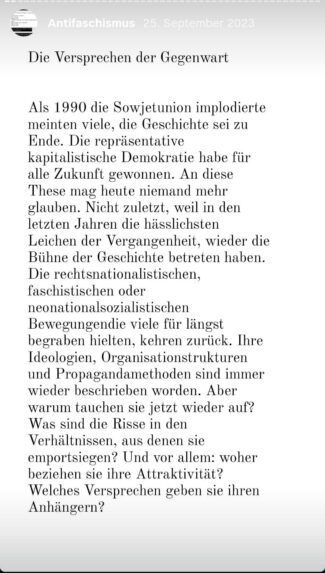
Adamczak setzt bei einer bekannten Erzählung an: Nach 1990 galt die repräsentative kapitalistische Demokratie vielen als endgültiger Sieger der Geschichte.
Doch die Geschichte war nicht zu Ende.
Rechtsnationalistische und faschistische Bewegungen kehrten zurück.
Adamczak fragt deshalb nicht nur danach, wie sie aussehen oder welche Propaganda sie benutzen.
Sie stellt die schwierigere Frage:
Was sind die Risse in den gesellschaftlichen Verhältnissen, aus denen sie hervorgehen? Und welches Versprechen geben sie ihren Anhänger*innen?
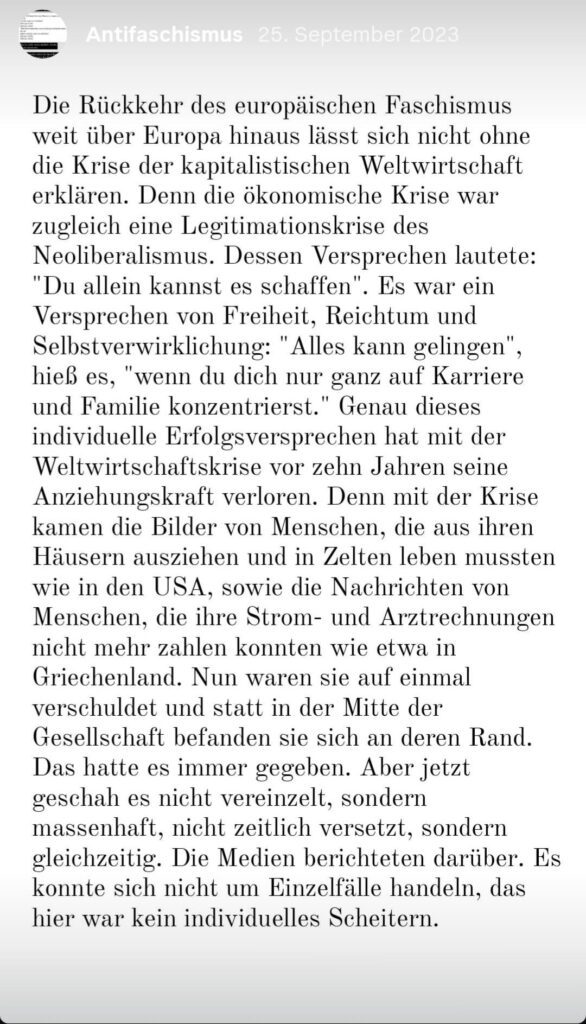
In ihrem Essay verbindet sie die Rückkehr des Faschismus mit der Krise der kapitalistischen Weltwirtschaft und einer Legitimationskrise des Neoliberalismus.
Das neoliberale Versprechen des individuellen Erfolgs – wer sich nur genug anstrengt, kann es schaffen – verliert an Glaubwürdigkeit, wenn gesellschaftliche Krisen für sehr viele Menschen gleichzeitig erfahrbar werden.
Damit verschiebt sich die Frage von:
Was stimmt mit diesen Menschen nicht?
zu:
Was stimmt mit gesellschaftlichen Verhältnissen nicht, in denen autoritäre Versprechen wieder attraktiv werden können?
Faschistische und ökologische Krise zusammendenken
Bini Adamczak verbindet diese Analyse außerdem mit der ökologischen Krise.
In einem Interview mit analyse & kritik formulierte sie bereits 2018 zwei Gefahren für linke Politik: die ökologische und die faschistische.
Die ökologische Krise verbindet sie mit dem Wachstumszwang kapitalistischer Ökonomien, die faschistische Gefahr mit der Notwendigkeit einer neuen Klassenpolitik.
Diese Verbindung bedeutet nicht, Klimakrise und Faschismus gleichzusetzen.
Sie stellt vielmehr die Frage, wie gesellschaftliche Krisen politisch bearbeitet werden.
Wer trägt ihre Kosten?
Wer darf auf Sicherheit hoffen?
Wer wird ausgeschlossen?
Und welche gesellschaftlichen Antworten können Solidarität an die Stelle von Konkurrenz und Abwertung setzen?
Was sich in der Krise befindet, ist die kapitalistische Demokratie. Die Wurzeln dieser Krise reichen Jahrzehnte zurück. Der Neoliberalismus hat die Fragmentierung der Gesellschaft vertieft. Viele Errungenschaften einer institutionalisierten Solidarität wie Arbeitslosen-, Kranken-, Rentenversicherung, Flächentarifverträge wurden ausgehöhlt. »Du allein kannst es schaffen« lautete die Parole. Die Weltwirtschaftskrise vor zehn Jahren hat gewaltsam in Erinnerung gerufen, dass diese Parole für die Mehrheit nicht stimmt. Auf die Frage nach Wegen aus der Individualisierung gibt es eine rechte und eine linke Antwort. Die rechte Antwort bietet einem Teil der Bevölkerung an, seinen Lebensstandard zu halten auf Kosten von Schwächeren. Was hier angerufen wird, sind Loyalität und Korpsgeist. Die linke Antwort richtet sich an alle, die unterdrückt sind, und geht als universelle noch darüber hinaus. Sie lautet Solidarität.
Adamczaks Begriff von Solidarität ist dabei ausdrücklich konkret. Sie verweist etwa auf Kämpfe gegen die Verdrängung eines bestimmten Ladens oder einer bestimmten Nachbarschaft, aus denen größere solidarische Strukturen entstehen können.
Damit sind wir wieder bei der Wohnungsfrage.
Eine Mieterin schickt Vonovia eine Rechnung
Ende 2025 veröffentlichte die taz ein Interview mit einer Berliner Mieterin, die Vonovia die Arbeit in Rechnung stellte, die sie über Jahre leisten musste, um ihre eigenen Rechte durchzusetzen.
Beschwerde-E-Mails schreiben. Heiz- und Betriebskostenabrechnungen prüfen. Sich in rechtliche Fragen einarbeiten. Anwaltstermine organisieren.
Nach ihrer Schätzung waren es in besonders intensiven Phasen mehr als 30 Stunden pro Woche. Ihre Rechnung an Vonovia: 500.000 Euro.
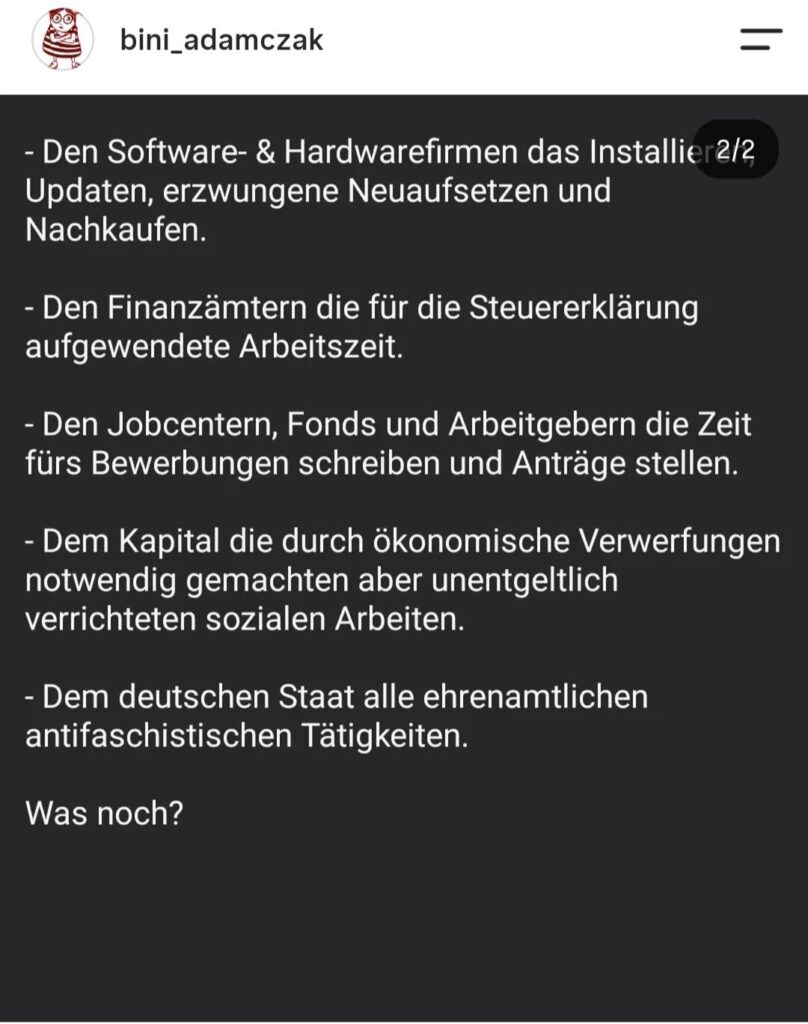
Adamczak erweitert die Idee spielerisch und zugleich grundsätzlich.
Was wäre, wenn wir Supermärkten die Arbeit an Selbstbezahlkassen berechnen würden?
Reiseanbietern die eigene Recherche und Onlinebuchung?
Banken die Zeit für Identitätsprüfungen und Authentifizierungsverfahren?
Social-Media-Unternehmen die Arbeit, die Nutzer*innen durch Content, Vernetzung und Interaktion leisten?
Und schließlich dem Kapital all jene gesellschaftlich notwendigen Arbeiten, die unbezahlt verrichtet werden?
Aus einem konkreten Mietkonflikt wird damit eine größere politische Frage:
Welche Arbeit bleibt unsichtbar, obwohl Unternehmen, Institutionen und Eigentümer*innen von ihr profitieren?
Gerade beim Wohnen ist diese Arbeit alltäglich.
Wohnungssuche, Antragstellung, Kontrolle von Nebenkosten, Reparaturmeldungen, Widersprüche, Kommunikation mit Hausverwaltungen, Anwält*innen und Behörden oder die Organisierung der eigenen Hausgemeinschaft kosten Zeit.
Wohnen produziert Arbeit.
Und ein Teil dieser Arbeit wird auf diejenigen ausgelagert, die gleichzeitig Miete bezahlen.
Hier schließt auch Sie nennen es Leben, wir nennen es Arbeit aus unserem Programm an: Welche Tätigkeiten sind gesellschaftlich notwendig, obwohl sie außerhalb klassischer Erwerbsarbeit unsichtbar bleiben?
Wie fühlt es sich an, reich zu sein?
Adamczak beschäftigt sich immer wieder auch mit der anderen Seite sozialer Ungleichheit: Reichtum.
Die Frage ist persönlich formuliert.
Ihre politische Dimension ist enorm.
Denn Reichtum und Armut sind nicht nur unterschiedliche Gefühle oder Lebensstile. Sie beruhen auf sehr unterschiedlichen Zugängen zu Eigentum, Einkommen, Sicherheit und gesellschaftlicher Macht.
Aktuelle Daten zu Erbschaften machen die Größenordnung sichtbar.
2025 wurden in Deutschland 141,1 Milliarden Euro an steuerlich erfasstem Vermögen durch Erbschaften und Schenkungen übertragen. Das Statistische Bundesamt weist darauf hin, dass Vermögensübertragungen innerhalb der Freibeträge in dieser Statistik nicht vollständig erfasst werden.
Eine Analyse des DIW Berlin zeigt gleichzeitig, wie stark große Erbschaften konzentriert sind.
Das ist für die Wohnungsfrage relevant.
Wer Immobilien oder anderes großes Vermögen erbt, startet unter völlig anderen Bedingungen als jemand, dessen Einkommen weitgehend für Miete, Energie und Lebenshaltung aufgebraucht wird.
Deshalb ist die Frage „Wer kann sich Wohnen leisten?“ nicht von den Fragen zu trennen:
Wer besitzt? Wer erbt? Wer arbeitet? Und wie wird gesellschaftlicher Reichtum verteilt?
Antirepression und die aktuelle Debatte um Elif Eralp
Die Wochen nach der Berliner Wahl haben noch eine andere Debatte sichtbar gemacht.
Die frühere Mitgliedschaft der Berliner Linken-Politikerin Elif Eralp in der Roten Hilfe wurde zu einem großen Medienthema.
Nach Angaben ihrer Partei war Eralp während ihres Jurastudiums passives Mitglied und trat 2025 wegen politischer Differenzen aus. Die Mitgliedschaft war öffentlich angegeben.
Die Rote Hilfe wird vom Berliner Verfassungsschutz als linksextremistisch eingestuft. Zugleich wird auch darauf hingewiesen, dass nicht alle Mitglieder selbst verfassungsfeindliche Ziele verfolgen.
Der Jurist und Journalist Ronen Steinke widersprach der Skandalisierung deutlich.
Er bezeichnete den Umgang mit Eralp als „Hexenjagd“ und verwies auf den rechtsstaatlichen Kern von Strafverteidigung:
„Ein Rechtsstaat ist nur dann fair, wenn es eine Strafverteidigung gibt im Strafprozess.“
Für edition assemblage ist diese antirepressionssensible Perspektive wichtig.
Menschen, Gruppen, Initiativen und soziale Bewegungen brauchen Informationen darüber, welche Rechte sie haben und wie sie sich mit rechtsstaatlichen Mitteln gegen Ermittlungen, staatliche Eingriffe und Repression verteidigen können.
Das gilt ebenso für Menschen und Initiativen, die rechten Bedrohungen ausgesetzt sind.
Auch Autor*innen der edition assemblage haben in die aktuelle Debatte eingegriffen.
Felicia Ewert, Autorin von Trans. Frau. Sein., kritisiert die Skandalisierung von Eralp in einem eigenen Statement als antikommunistische „Red Scare“-Erzählung.
Das ist Felicia Ewerts eigene politische Einordnung.
Wir machen sie sichtbar, weil Autor*innen unseres Programms selbst Teil gesellschaftlicher Auseinandersetzungen sind.
Ihre Aussagen sind dabei nicht automatisch identisch mit einer einheitlichen Verlagsposition.
Das ist uns gerade bei kontroversen Fragen wichtig.
Solidarität heißt nicht Kritiklosigkeit
Eine antirepressionssensible solidarische Perspektive bedeutet für uns nicht, antisemitische oder autoritäre Strukturen innerhalb linker Zusammenhänge zu relativieren.
Im Gegenteil.
Kritik an Antisemitismus muss auch dort möglich sein, wo er in linken Parteien, Bewegungen oder politischen Milieus auftritt.
Die Untersuchung der Bertelsmann Stiftung von 2025 zeigt dabei ein komplexes Bild.
Antisemitische Einstellungen finden sich in unterschiedlichen politischen Lagern. Je nachdem, welche Form von Antisemitismus abgefragt wird, unterscheiden sich die Ergebnisse erheblich.
Bei einem klassischen antisemitischen Stereotyp lag die Zustimmung unter befragten Linke-Wähler*innen beispielsweise unter derjenigen bei AfD-, CDU/CSU- und SPD-Wähler*innen.
Bei einem israelbezogenen NS-Vergleich war die Zustimmung unter den befragten Linke-Wähler*innen dagegen besonders hoch.
Solidarische Antirepressionsarbeit und Kritik am Knast und Antisemitismuskritik sind für uns deshalb keine Gegensätze.
Menschen müssen ihre Rechte gegenüber staatlichen Eingriffen verteidigen können.
Menschen müssen vor rechter, rassistischer und antisemitischer Gewalt geschützt werden.
Und antisemitische, rassistische und autoritäre Strukturen müssen auch in den eigenen politischen Zusammenhängen kritisierbar bleiben.
Warum unabhängiges Publizieren wichtig ist
Die aktuellen Auseinandersetzungen zeigen zugleich, wie schnell politische Konflikte auf einzelne Personen, Schlagzeilen und kurze Nachrichtenzyklen reduziert werden.
Kritische Medien und journalistische Recherche sind unverzichtbar.
Aber unabhängiges Publizieren kann etwas leisten, das im schnellen Nachrichtentakt häufig schwer möglich ist:
Zusammenhänge über längere Zeiträume sichtbar machen.
Widersprüche stehen lassen.
Historische Erfahrungen erinnern.
Stimmen aus sozialen Bewegungen dokumentieren.
Und Diskussionen führen, ohne sie auf eine Person oder den nächsten Aufreger zu reduzieren.
Gerade unsere Autor*innen zeigen, dass emanzipatorische Öffentlichkeit keine einheitliche Stimme sein muss.
Tanja Abou kritisiert Klassismus auch innerhalb antifaschistischer Diskurse.
Felicia Ewert interveniert gegen eine aus ihrer Sicht antikommunistische Skandalisierung.
Bini Adamczak fragt nach den gesellschaftlichen Bedingungen, die autoritären und faschistischen Versprechen wieder Attraktivität verleihen – und verbindet diese Frage mit Kapitalismus, sozialer Ungleichheit, ökologischer Krise und Solidarität.
Sebastian Friedrich untersucht, wie neoliberales Leistungsdenken, Rassismus und rechte Verschiebungen miteinander verbunden sein können.
Andere Bücher unseres Programms kritisieren Antisemitismus in linken Zusammenhängen oder vermitteln Wissen über staatliche Repression.
Diese Unterschiede wollen wir nicht glätten.
Unabhängiges Publizieren bedeutet für uns auch, Räume für genau solche Auseinandersetzungen offenzuhalten.
Zurück zum World Habitat Day: Wem gehört die Stadt?
Am Ende führt vieles zurück zur scheinbar einfachen Frage nach dem Wohnen.
Wer kann in einer Stadt bleiben?
Wer wird verdrängt?
Wer besitzt Wohnungen?
Wer zahlt Miete?
Wer erbt Immobilien und Vermögen?
Wer leistet unbezahlte Arbeit, um überhaupt zu seinem Recht zu kommen?
Wer wird als „leistungsfähig“, „vernünftig“ oder gesellschaftlich „nützlich“ bewertet – und wer nicht?
Und wie werden die daraus entstehenden Konflikte politisch erklärt?
Die Bücher unseres Programms geben darauf keine einzige gemeinsame Antwort.
Das ist ihre Stärke.
Welches Zuhause? erzählt Wohnungsnot aus der Perspektive Betroffener.
Unsere Bücher über Klassismus, Neoliberalismus, Antifaschismus, Antisemitismuskritik und Antirepression erweitern diese Perspektive.
Wohnen ist mehr als ein Dach über dem Kopf.
Es geht darum, wer bleiben kann und wer verdrängt wird.
Wer besitzt und wer bezahlt.
Wer arbeitet und wessen Arbeit unsichtbar bleibt.
Wer über Sicherheit verfügt und wer jeden Monat neu darum kämpfen muss.
Und schließlich darum, ob soziale Unsicherheit in Solidarität, demokratische Organisierung und Veränderung übersetzt werden kann – oder in Abwertung, Ausgrenzung und autoritäre Antworten.
Der World Habitat Day ist für uns deshalb nicht nur ein Anlass, Bücher über Wohnen zu empfehlen.
Er ist ein Anlass, die Wohnungsfrage als soziale und demokratische Frage zu stellen – und die unterschiedlichen Stimmen sichtbar zu machen, die seit Jahren an ihr arbeiten.
Der Titel „Wir sind die Guten“ stellte eine unbequeme Frage an die eigene politische Selbstgewissheit: Schützt eine antifaschistische, antirassistische oder linke Selbstverortung automatisch davor, antisemitische Denkweisen zu reproduzieren?
Die Beiträge beschäftigten sich unter anderem mit Antisemitismus in antifaschistischen Zusammenhängen, mit Kontinuitäten nach dem Nationalsozialismus sowie mit dem Verhältnis der radikalen Linken zu Israel und Palästina. Ein zentraler Impuls war, Antisemitismus in den eigenen politischen Zusammenhängen überhaupt besprechbar zu machen, statt ihn ausschließlich beim politischen Gegner zu suchen.